
Ecuador climbing FAQ
This Ecuador climbing FAQ gathers the questions Diego hears most often from climbers planning Cotopaxi or Chimborazo: how a request works, how to get ready for the altitude and what really happens on summit night. If your question is missing, write to us and Diego answers you personally.
Ecuador climbing FAQ: booking and payment
This first FAQ section explains how requests, prices and private groups work, from your first message to the WeTravel payment link.
How do I book a climb with Ecuador Ascents?
Choose a climb, your group size and a start date, then send a request from the climb page or the contact form. Diego checks guides and dates and replies by email or WhatsApp with availability. When everything fits, he sends you a secure WeTravel payment link to complete the booking.
Is a request already a booking?
No. A request only tells Diego what you have in mind, and sending it costs nothing. You pay only through the WeTravel link he sends after confirming availability, so you can ask about more than one date without any commitment.
How is the price calculated?
The price is per person by group size, and it goes down as your group grows. Each climb page shows its own table, like the one on our Cotopaxi climb. From 5 people the group gets its own quote, so tell us how many you are.
Are the climbs private?
Yes. Every climb on this site is private for your group, whether you are one person or a whole club. You choose the date and climb only with your own people and your guides. If you travel alone and would rather share a date with other climbers, the FAQ on our shared departures page explains how they work.
Can a large group or a club climb together?
Yes, large groups are welcome. We add guides so that every rope on the glacier keeps at most 2 climbers per guide, and from 5 people your group gets its own quote. Write with the number of climbers and your dates, and Diego plans the logistics from Machachi.
Which days can we start?
Both climbs run any day of the year. Pick the start date that suits your trip and Diego confirms whether guides are free. If your trip has only a few free days, send us all the options you have and we find the one that works best.
What does the price include?
An ASEGUIM certified guide, private transport from Machachi, the night at the refuge or high camp, the meals on the mountain, the Cotopaxi National Park entrance, the technical gear, communication with the guides and the office, and evacuation assistance. Travel and mountain insurance, personal clothing and gear, lunch and snacks on summit day and tips are not included.
Can you plan another mountain or a longer program?
Yes. This FAQ covers our two climbs, but if you want other mountains, more acclimatization days or a trek, tell us your idea and we plan it with you. Write to Diego through the contact page with your dates, your experience and what you would like to climb.
Get ready for the altitude
This part of our Ecuador climbing FAQ covers fitness, experience and acclimatization, the three things that decide most summit nights.
How fit do I need to be?
You need good fitness. Summit night on Cotopaxi means about 6 to 8 hours of steady climbing on the glacier, then around 3 hours back down to the refuge, all above 4,800 m. Regular endurance training in the months before, such as hiking, running or cycling, makes a real difference.
Do I need previous climbing experience?
Previous high-altitude experience is strongly recommended, and glacier experience helps. You don't need to be an expert with ropes: before summit night your guide reviews with you how to walk in crampons, use the ice axe and move on the rope.
Why does acclimatization matter so much?
Your body needs time to adapt to thin air, especially if you arrive from a low elevation. Spend some days at altitude and do acclimatization hikes before the climb. We can add those days to a custom trip, or you can sign up for shared acclimatization climbs, explained on our join a group page.
Cotopaxi or Chimborazo: which should I climb first?
When is the best season to climb in Ecuador?
You can climb all year. The drier months are usually June to August and December to January, but weather in the high Andes can change quickly in any month, so your guide decides each summit night based on the conditions.
What should I bring?
The technical gear is included, so you bring your personal clothing and gear: warm layers, a waterproof jacket and trousers, warm gloves, a hat, sunglasses, sunscreen, a headlamp and a backpack. Pack your own lunch and snacks for summit day too, since they are not included. If an item is not in this FAQ and you are unsure about it, ask us before you travel.
Do I need travel insurance?
Travel and mountain insurance is not included, so we recommend a policy that covers mountaineering at high altitude, arranged before you travel. Evacuation assistance is part of every climb, but it does not replace your own insurance.
Can I rent gear for days outside the climb?
Yes. Our rental gear page has its own FAQ and lists the technical pieces you can pick up at the Machachi office, such as plastic mountain boots, crampons and an ice axe. Write with the items, your sizes and your dates, and we send you the price.
What happens on the mountain
The last FAQ section follows the two days of a climb, from the departure in Machachi to the drive back.
Where does the climb start and end?
Every program starts and ends in Machachi, on the Avenue of the Volcanoes south of Quito, close to Cotopaxi and the Ilinizas. Your gear is checked there before you leave, and private transport takes your group to the mountain.
Where do we sleep?
On Cotopaxi you sleep at José Rivas Refuge (4,800 m), about an hour's hike from the parking area at around 4,500 m. On Chimborazo you sleep at a high camp in the Chimborazo Wildlife Reserve. Either way the night is short: you rest after dinner and get up around midnight.
What happens on summit night?
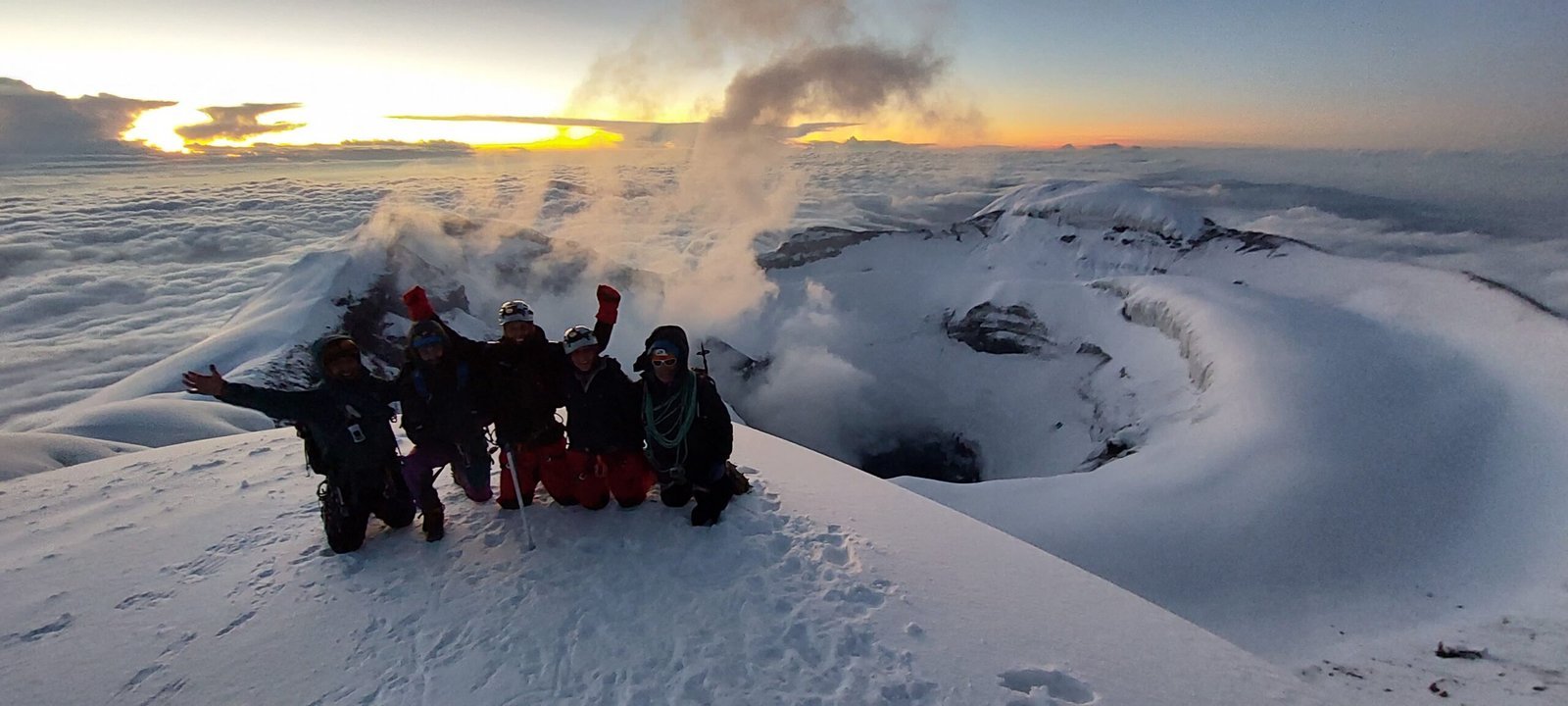
On Cotopaxi you get up around midnight and start at about 1:00 a.m. The climb to the summit takes 6 to 8 hours on the glacier, roped to your guide, with crampons and ice axe. The descent to the refuge takes about 3 hours, and then you drive back to Machachi. Chimborazo follows a similar rhythm from its high camp.
How many climbers go with each guide?
On glaciers each guide takes at most 2 climbers, and large groups climb with more guides. All our guides are professional mountain guides certified by ASEGUIM, the Ecuadorian Association of Mountain Guides.
Which meals are included?
The meals on the mountain are included: on Cotopaxi that means dinner at the refuge and breakfast before the climb. Lunch and snacks for summit day are not included, so bring food you enjoy eating at altitude, such as nuts, chocolate or energy bars.
Is the summit guaranteed?
No, and no FAQ answer matters more: the summit is never guaranteed. Your guide decides on the mountain based on the weather, the state of the glacier and each climber's condition. Turning back in time is part of climbing safely, and good acclimatization gives you the best chance.
What safety support do we have?
Your guide stays in communication with the other guides and the office during the climb, and evacuation assistance is included. The gear is checked in Machachi, and the guide goes over crampon, ice axe and rope technique with you before summit night.
What makes Chimborazo special?
At 6,263 m (20,548 ft) it is Ecuador's highest mountain, and because of the equatorial bulge its summit is the point on Earth's surface farthest from the planet's center. You can read more on Wikipedia or see our Chimborazo climb.
Ask Diego directly
If this Ecuador climbing FAQ didn't answer your question, write to Diego with your dates and group size. He replies personally by email or WhatsApp.